
Was I Supposed to Like Licorice Pizza?
- Calan Mengel

- Feb 4, 2022
- 10 min read
As a film student, this movie made me stop and think... what did I just watch? Was I supposed to like it?
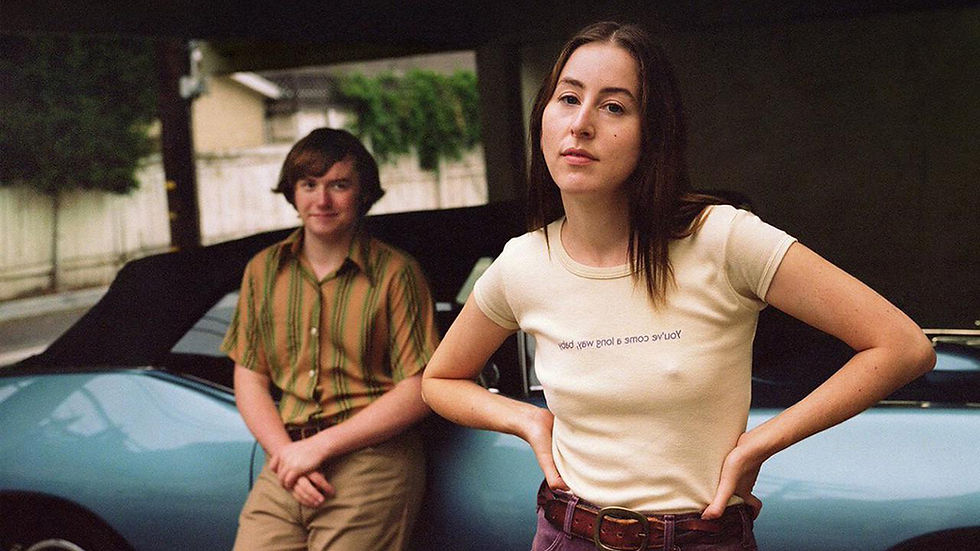
Characters Gary Valentine (Cooper Hoffman) and Alana Kane (Alana Haim) in one of the most notable marketing photos. Photo from https://ucsdguardian.org
***WARNING: SPOILERS FOR LICORICE PIZZA***
Sometimes movies are not made for us. They are made to target a specific audience, or they were made a long time ago and have become 'outdated' to general audiences, or they are experimental and not everyone will understand them. There are few times I find myself in a situation where I watch a movie like this: in my old cinema history classes, or while I'm browsing Netflix for a Friday night film and do the '10 minute test' (watch the movie, documentary, or show for 10 minutes... if it's not for me, I turn it off).
Licorice Pizza has became the most recent on my list.
Before anyone gets upset (and yes I know this movie has an 7.9/10 on IMBD's website as of January 23, 2022), I'd like to present my case: Licorice Pizza had some interesting visual, individual, and professional industry elements that I enjoyed, but the use of specific elements that felt uncomfortable and off-putting, mixed together with a less than mediocre storyline in my eyes, created a situation I just didn't care for.
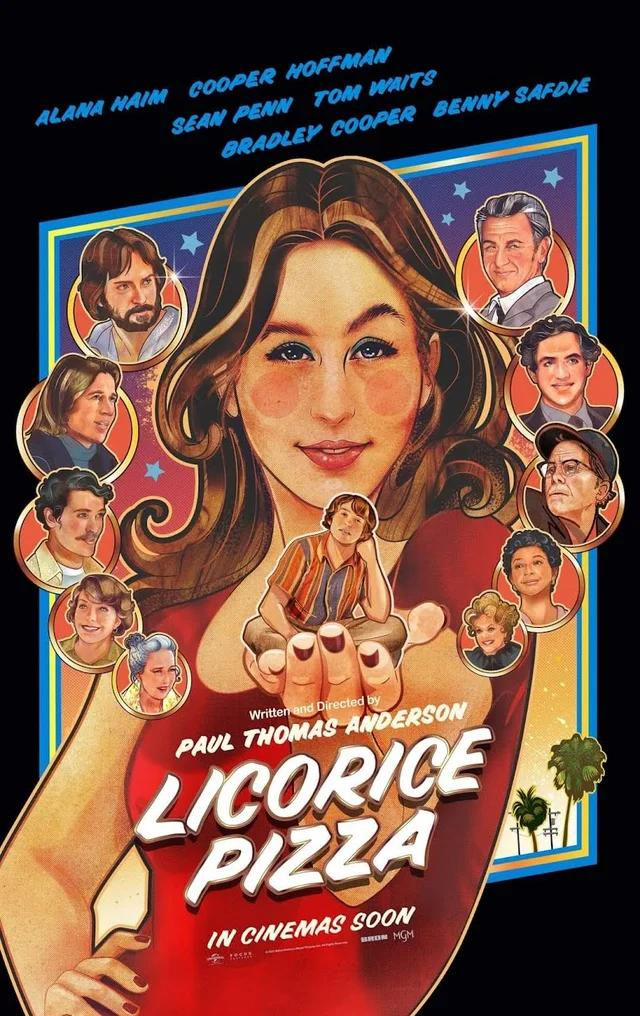
The really beautiful poster for Licorice Pizza, designed by Kat Reeder, a Peruvian-American artist based in Honolulu, Hawaii. Check out her website here!: https://katreeder.com
Let me take you back to the day I saw the Licorice Pizza. It was late December of 2021, a bit after the movie's release. My aunt really wanted to go see the movie and nobody would go with her, so I offered to accompany her. I love going to the movies, so we drove to the local theatre and got ourselves settled for the film.
Going into the film, I only knew so much. I knew, from the promos, that this was a love story. I also knew that Alana Haim, one of the band members from one of my favorite female-led bands, Haim, had a lead role (cool!). I also knew the film took place in the 70's, and that it seemed to be very visually pleasing. As a producer, I could tell the main ticket to selling, well, tickets, was that this movie was going to bring nostalgia to anyone who lived through the 70's.
To better discuss this film, I'd like to chunk my stream of thoughts and aftermath research into three sections: pros, neutrals, and cons.
Pros: Cinematography, Professionals on Deck, Haim, and More
It's extremely clear that the cinematography in this film is top-notch. With both director of photographies being credited to Paul Thomas Anderson and Michael Bauman, I'm not surprised these two a) worked together on this film, and b) did such a fantastic job.
Anderson and Bauman don't use traditional coverage at all times. Sometimes, we are viewing the scene from a different angle in a way where we can still see and understand the scene, just in a more interesting way. There is a scene outside (I forget if it's outside the water bed store, or outside the police station... it has been about a month since I've seen this movie) where Alana and Gary and standing and talking. It's an intense moment, where both characters are upset to a degree. Instead of us watching it with long shots, medium shots, close ups, edited in a way to enhance the pressure, we are facing the store window and seeing their reflection. The camera does not move, but instead waits on their reflected images.
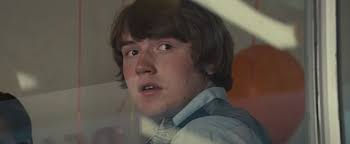
While it's not the scene I was mentioning, you can get a taste of these reflection shots here in this screen cap. Photo sourced from The Focus.
This new viewpoint causes the audience to perk up and listen closer to the conversation at hand. Our character's are not directly in the center of the frame either, so our senses urge us to lean forward a little, watch closely, and make sure we're paying attention. I give much applause to the cinematography done in this film.
I'm also very impressed with the cast and crew that was put together for Licorice Pizza. Again, we have Paul Thomas Anderson, who is infamous for Boogie Nights and There Will Be Blood amongst other films, and Michael Bauman, who has worked on Iron Man, The Island, and Hunger Games: Catching Fire. We also have the extremely talented female rock group Haim, one of my favorite singer groups to date. Obviously Alana Haim was the star, but I really chuckled when I realized the whole Haim family was actually in the movie (very clever).
My final main praise I'd like to give to the film goes to the poster artist, Kat Reeder. I believe this poster, as well as many other artwork you can find for the film, really hits that 70's style. Make sure to check out her website using the links at the end of the article.
Neutrals: Storyline and Character Moments
This movie was not made for the plot. Rick Bentley's Review on KGET.com put my exact thoughts in the best words possible:
"It is pure Anderson but when he is taken out of the equation, the sequence just looks like the kind of moments writers produce at 4 a.m. after two days of no sleep."
This piece wasn't structured in a linear fashion, which is my personal preference. But just because the storyline wasn't straightforward doesn't mean I didn't understand why, or that there weren't still decent movie and character moments that caught my attention and eye.
For example, the biggest and longest portion of the film that interested me was the getaway truck scene, where Alana and the boys are driving the waterbed moving truck away from the anger-driven Jon Peter (Bradley Cooper). The way this sequence was edited was really impressive. I was invested in watching Alana navigate their empty-tanked truck on the roads using the uphills and downhills to get everyone to safety. This was a huge growing moment for the character of Alana, and I, along with Gary and the boys, were here for it.
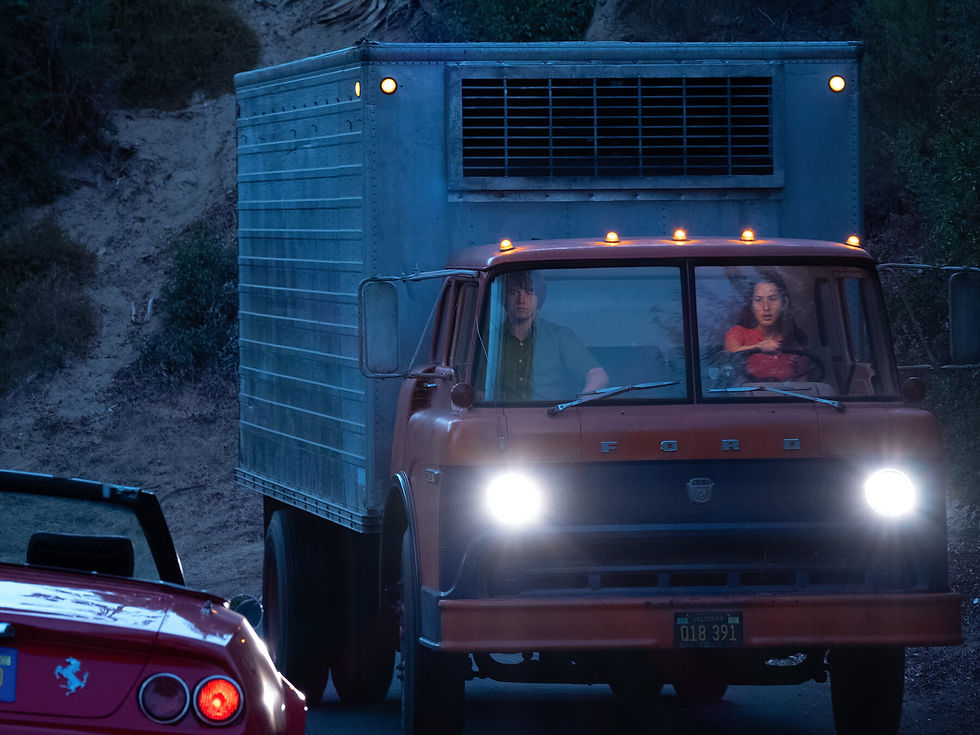
The moving truck from the movie where Alana is at the wheel. Photo sourced from The New York Times.
As for character moments, there were many interesting ones. The whole idea that Gary is this young entrepreneur that is treated older than he is was a neat concept. The idea of Alana just trying to figure her life out is an interesting concept. Same for some other plot happenings; the idea we see our characters during the Energy Crisis of the 70's, the idea we see our characters around the showbiz industry filled with angry women and cigarettes, the idea we see an ad for 'Deep Throat' in the newspaper'. These are all great moments, but they do not concisely move together in a format that works for the majority of audience members.
Cons: Overall Storyline, Underage Relationships, Limited Audience Reach, and More
I'd like to give a disclaimer to this section that it is entirely okay to disagree with my, for again, this is an opinions article. There are a few key reasons as to why I disliked the movi, all of which I have some backings for:
1. The overall storyline was not linear and often had me falling asleep and bored in my seat, or frustrated that there was not a cohesive plot.
As mentioned before in the last section, I can tell this movie was not made for the plot. As Christy Lemire stated in her article on Roger Ebert's Website, "We haven't even begun discussing the plot, but then again, the plot isn't really the point." I understand the argument given here, but I must politely disagree. This hurts me as a student and a storyteller, for I crave solid storylines that make me feel something, especially when it is entirely possible to do so in order to emotionally move millions of people. This, unfortunately, did not.
2. The underage relationship made me personally uncomfortable; Gary being 15 and Alana being 25.
I've seen some other reviews point this out as well. Underage relationships, no matter who's age is what, rubs me the wrong way. I understand that there was sort of a reasoning behind this, being that Gary is so young, but so well spoken as a business man he seems older than he is. I understand, but this is not for me.
Additionally with this point, the positive side for some viewers is that Anderson never really clearly states what their relationship is. Any scene that occurs is never clear whether Gary and Alana are romantically involved or people that stumbled into each others lives. It constantly changes, which keeps the audience on their toes.
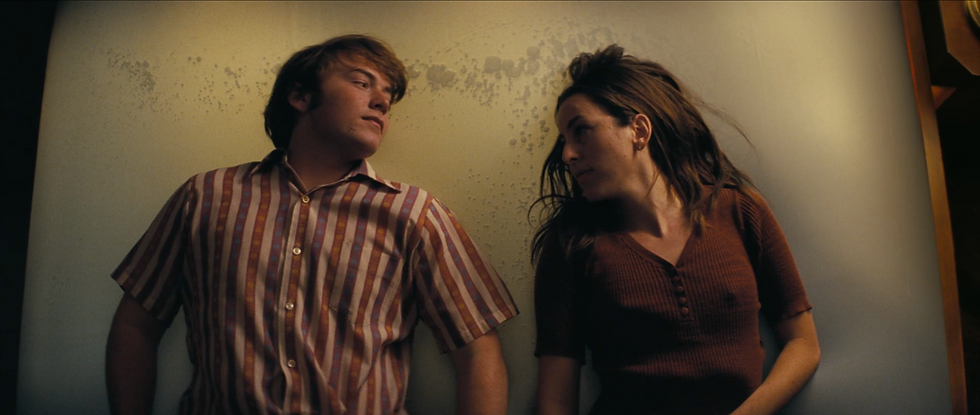
The scene where Gary and Alana lay next to each other on a water bed. What is their relationship? It's for the audience to contemplate. Photo sourced from Tom Cendejas's article on Bright Wall/Dark Room.
3. There was blatant racism towards Japanese women characters, Mioko and Kimiko by the restaurant owner character, Jerry Frick, that did not actually advance the plot in any way, shape, or form.
This one I really had a hard time with. When the scene with character Jerry Frick and his first Japanese wife, Mioko, first debuts in the office with Gary and his mother, it's offputting how Jerry speaks to his wife, let alone can't actually understand what she's saying. It's even more uncomforting that later we see Jerry again when Alana and Gary go to speak to him at his Japanese resturant, that he is now with a second wife, Kimiko, and that he treats her just as he did Mioko.
Rebecca Sun from The Hollywood Reporter wrote a fantastic article dissecting this problem and provided some very interesting information (see the 'Sources' section for a link). For one, the Media Action Network for Asian Americans, a watchdog group, ended up "decrying any awards recognition for the movie" because, "The scenes do not appear to be integral to advancing the plot... and serve mostly as “color” to flesh out the film’s hyperspecific, historically inspired setting — as well as to play into the well-worn trope of deploying casual anti-Asian racism in the name of art."
It seems many folks on the opposing team, including Anderson himself, defend the scenes by explaining that it was normal for that time in the 70's, and that the mocking and hate towards this group was normalized, even though it is not today. I must disagree with this notion, again, due to the strong points MANAA mentioned with no advancing to the plot specifically.
4. This film targets those who grew up in the 70's or in California specifically at that time, which limits your pool of excited and interested audience members (this is a personal spiel, I completely understand if you do not agree with me on this topic).
Again, disclaimer that this is a personal thing, I completely understand and welcome disagreement. In my producer eye, there are pros and cons to this film:
Pros: You are hitting a decent market of those born in the 70's and or interested in 70's culture.
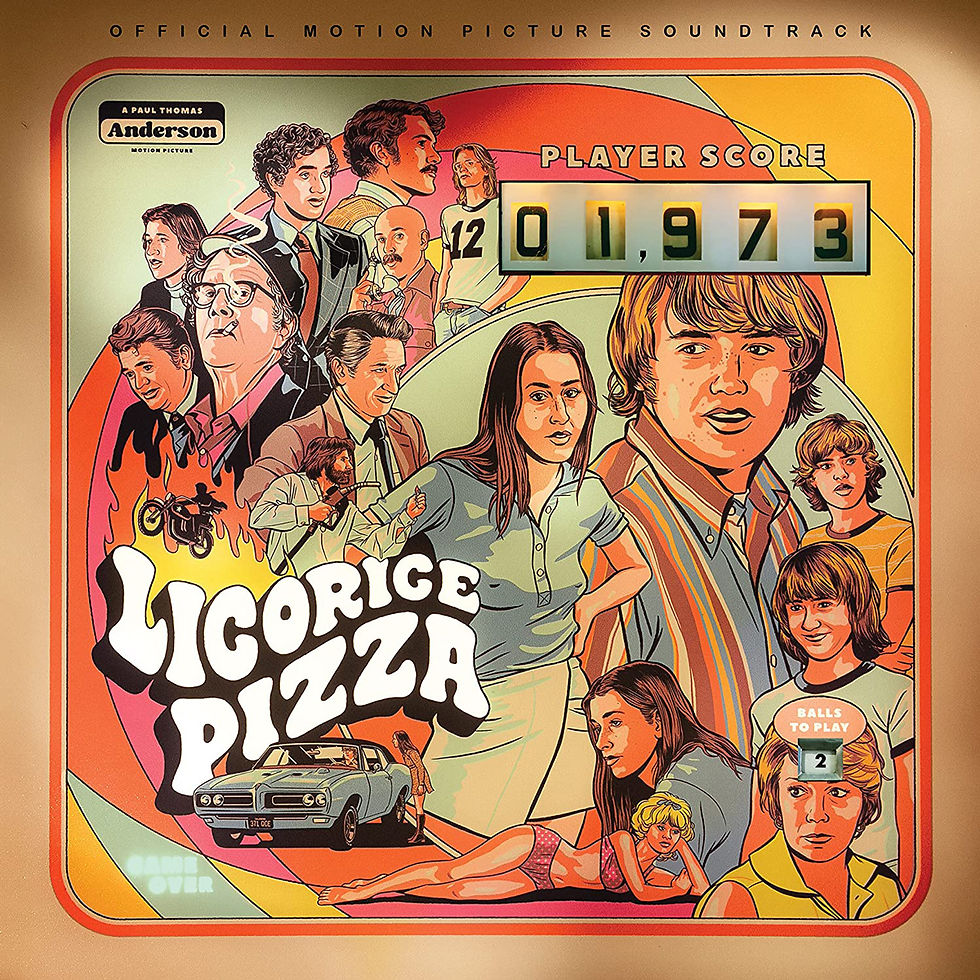
Look at this vinyl of the original soundtrack. How much more 70's can you get? Photo sourced from The Vinyl Factory.
Cons: You are not hitting a market that is larger than that group of 70's or interested 70's folks, which is anyone who lived in the 80's and beyond
Take a story like the ones Pixar and Disney produce. Let's go with the most recent Spider-Man movie that came out, Spider Man: No Way Home. I'm not the biggest Marvel fan and don't know all the lore, but when I went to see this, I was completely invested. So, why do these films make so much money, and why do they get so many positive reviews?
For one, they take large chunks of time solely on story development. Two, they have the money to do so (not that MGM didn't have that money for Licorice Pizza, being one of the greats and that the movie cost 40 million USD to make). And three, they constantly hit a HUGE pool of viewers ranging from elementary school to late adulthood. That's not what Licorice Pizza aims to do, and with intention.
5. There seems to be a stigma around rating this movie with positive reviews showing that you 'understand' the movie.
In my opinion, Rick Bentley put it best in his review on KGET.com:
"“Licorice Pizza” is the kind of feature film that movie critics are not only supposed to love but regale it with the kind of kudos that make those who don’t understand its quirky approach feel embarrassed for their ignorance. "
Think about how you feel when you're talking with a new group of people and they are raving about a film and they look at you funny when you say you don't like it. It's that kind of artsy mindset that if you don't understand it, you're not part of the 'in' crew. As Bentley also mentions in his article, he understands why this is, especially with Paul Thomas Anderson being the director, and I agree. Anderson is a well-known and well-praised artistic individual, so some may feel pressured to like his work because it is 'art'. The truth in the matter is that not every single piece of art is for everyone.
Finally, Bentley also mentions, "It should be obvious from the name of the film that Anderson is more interested in things in life that clash more than those that connect. His “Licorice Pizza” is slice after slice of an odd idea that creates the kind of offering critics should like. Should like and do like are two very different things.", and I believe that is really something each individual should think about.
Conclusion
So I think the answer is decently clear: no, I wasn't supposed to like it, and it's mostly due to age difference, morals, and values of myself to the targeted audience. This just was not a movie for me, but that doesn't mean there were times I really enjoyed myself, such as with the cinematography and some story moments.
And if this was a movie for you, that's great! I'm glad that a group of people were able to make a piece of art that you enjoyed or could personally relate to, that's the purpose of filmmaking.
I believe that due to my many pros and cons of this film, while it wasn't my favorite, it will be one I remember for a long time.
Sources:
Licorice Pizza IMDB Page - https://www.imdb.com/title/tt11271038/
Review on Rotten Tomatoes - https://www.rottentomatoes.com/m/licorice_pizza
Christy Lemire's Licorice Pizza Review on Roger Ebert's Website - https://www.rogerebert.com/reviews/licorice-pizza-movie-review-2021
Ben Nicholson's Review on BFI's Website - https://www.bfi.org.uk/sight-and-sound/reviews/licorice-pizza-meandering-trip-beneath-california-sun
Rick Bentley's Review on KGET.com - https://www.kget.com/community/ricks-reviews/licorice-pizza-kind-of-film-critics-are-supposed-to-embrace/
The Art Of Kat Reeder's Poster Blog Post - https://katreeder.com/blogs/kat-chats-a-sporadic-art-blog/yes-im-the-licorice-pizza-poster-artist
Analysis: A Close Reading of ‘Licorice Pizza’s’ Japanese Wife Scenes written by Rebecca Sun: https://www.hollywoodreporter.com/movies/movie-features/licorice-pizza-analysis-asian-accent-criticism-1235068375/


Comments