
Gear that helped build my career
- Griffin Sendek

- Sep 15, 2023
- 5 min read
I'm going to walk you through some of the important pieces of camera gear I owned throughout the years and how they were fundamental to me first becoming a professional photographer. Remember, gear is never what matters most; it's the education, skills, and creativity behind the camera that makes a photographer. Gear is just the tools that help bring the vision to life.
Where it all started...
Nikon d3300
My very first DSLR, this entry-level camera, will always have a special place in my heart. I received it for my 16th birthday after expressing a budding interest in photography. This camera spent the majority of its first years of life collecting dust in my closet until 2018, when I began photographing the shows at my university's theater. that's when I decided I wanted to learn how to properly operate this camera, and learn the ins and outs of photography.
Not the latest and greatest camera of the time, it didn't have all the bells and whistles but it had everything I needed at the time and was the perfect vessel for me to learn and slowly develop into the photographer I am today.

Amazon Basics Tripod
Not the best tripod by any means but certainly not the worst. While limited in functionality and definitely not great for smooth panning and tilting for video, this for the most part, held my camera steady, and that's all I really needed at the time. For something less than $25, it was surprisingly well-built and continued to do its job for many years. For anyone just starting out in photography or filmmaking, I recommend not splurging on a heavy-duty tripod and just grabbing something cheap and simple.
Canon tx

Like seemingly every artsty college boy my age I went through a film photography phase my sophomore year. Shooting film, while cost-preventative, (even more so today with soaring film prices), but loads of fun and one day soon I hope to dust of my film camera collection and add 35mm film back into my photography workflow.
Funnily enough, it was shooting on a manual film camera that taught me how to properly use my digital camera, and I honestly believe it was the spark that pushed me to pursue photography as something much more than a hobby. Before shooting film I had a vague idea of what aperture, shutter speed, and iso were and how they affected the image, but for the most part, I was really still shooting from the hip, turning dials and hitting buttons, hoping the image would turn out how I wanted.
In order for my images to not be completely ruined I needed to actually know what each fo the setting actually meant and how they affected both the exposure and creative look of the photo. Additionally, film photography forced me to slow down and really think about every photo I took. In a time where you can fire the shutter faster than a machine gun, being forced to slow down was exactly what I needed.
Nikon dx 50mm 1.8
For most photographers, The 50mm 1.8 lens or the “Nifty-Fifty” as it is commonly known, is the first new lens we buy for our cameras. Switching over to this lens was absolutely mind-blowing; it legitimately felt like I had a brand-new camera.
If you’re still using your first camera with the packaged-in kit lenses, and you’re feeling the need to upgrade, I’d consider picking up a 50mm prime first. I felt like I was bumping up against the limitations of my camera, the photos weren't sharp enough, it wasn't good enough in low light, and wasn't capturing the creative look I wanted. All of that changed with a simple change of a lens.
Had I known more about focal length, and aputure, and the difference higher quality glass could make, I likely would have upgraded sooner, but that's the nature of being a self-taught artist.
While I've owned a DSLR and have been taking photos since 2015, It wasn't until 2019, after I bought this lens, that I began actually calling myself a photographer; that's truly the difference this one lens made.
Neewer led studio lighting kit

In the process of taking photography more seriously, I wanted to learn how to shoot in studio, knowing the Pittsburgh weather, I was aware that a majority of the year was not going to be pleasant for outdoor and location shooting, so shooting in my own little apartment studio was going to be necessary.
As the story of the majority of the gear I've owned up to this point, these lights weren't the biggest or brightest but were everything I needed at the time, these lights were the my love for studio photography and getting creative with lighting. There wasn't too much I could do with these at the time but they served me well for years.
godox sl60w+ Softbox
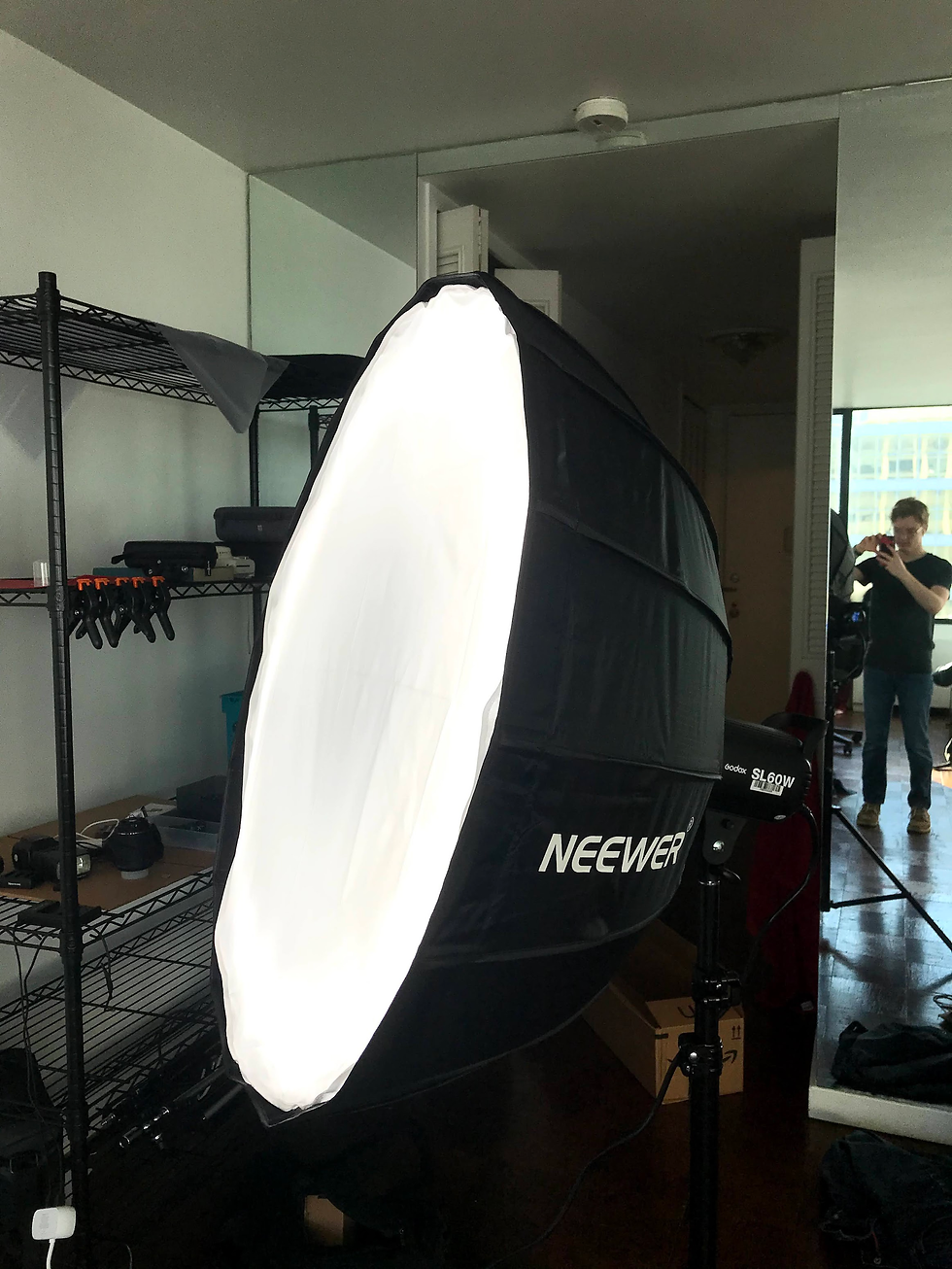
I reached a point where the current lights I had weren't quite cutting it any more and to photograph the type of portraits I was interested in I needed lighting that was both 1. Much Brighter and 2. much softer. That's where this light and softbox comes in. This 60-watt LED was enough to illuminate my entire room and when it came to portraits it could produce this beautiful soft light on my subjects. After I purchased this light and softbox combo It was used in every single one of my photoshoots up until I eventually upgraded the to a stronger 100-watt LED. This light was the beginning of my slow creep into much more professional-level gear.
sony a7iii

Eventually, there came a time to upgrade; at the very end of 2020 I felt secure enough in both my skills and passion for photography that I could justify dropping the nearly $3000 on a new Dony mirrorless camera. And it was one of the best decisions I've ever made.
Up until this point, all the camera gear I purchased was very budget and beginner-friendly, never going over a few hundred dollars. This camera body alone likely cost more than all the gear listed above combined. That's why upgrading to professional gear is not something to be taken lightly, in addition, it's not something to do until you're truly ready. Professional gear is chock-full with so many more features and settings that is far too overwhelming for someone just starting out. I'd had my original camera for five years and I it wasn't until I was bumping up against the technical limitations of my original Nikon that I knew it was time to upgrade.
And a big upgrade this camera was indeed, it blew everything I had before out of the water. I was able to see the vast improvement in my work almost immediately. I don't want to say that this camera alone allowed me to take better photos because the truth is, all the learning and practice up to that point did the heavy lifting, but rather this upgraded model was able to remove so many of the hurdles and limitation that were holding my back from capturing the photos and moments that I had always wanted.
As my career continues and this list gets longer and longer I'll always remember some of the humble beginnings of entry-level gear I barely knew how to use. And that's the reality of most of your favorite artists; none of them likely had any idea of what they were doing, nor did they have access to the latest and greatest tools, yet they continued nonetheless. It's so easy to view someone after they've firmly established themselves and think they must have "always been like that." in reality, we all start somewhere, and the best time to start is right now.


Comments