
Visit the Damn Public Library
- Calan Mengel

- Apr 7, 2023
- 5 min read
Updated: Sep 3, 2023
Go to your local public library and expand your storytelling skills.

The famous New York Public Library. Photo sourced from TripAdvisor.
The first recorded story of all time was The Epic of Gilgamesh in 2100 BCE. It was written on clay tablets.
The first film ever made was The Horse in Motion by Eadweard Muybridge in 1878. Or you may argue, content-wise, it was Roundhay Garden Scene by Louis Le Prince in 1888. Or Arrival of a Train by the Lumiere Brothers in 1895. Either way, they were all made in the late 1800's.
The main point is that we have been telling stories forever.
When ideas stop flowing and you're stuck in a creative rut, can be important to go back to your roots, to physical records of storytelling, that eventually evolved, meshing with cameras and lights and timing and scripts. As creators associating in a craft that has lasted many centuries, we must always be on the hunt for inspiration. We need to find new ways to tell stories (or retell stories). This is especially true for screenwriters, but affects all departments equally.
The public library is a free-to-use story hub that houses thousands of resources for us, yet it tends to get overlooked. Why don't we use or talk about libraries as much as we could? Do we find ourselves to be "above" or "better" than those who visit the library? Have we, as adults, outgrown the facility, compared to the small children who visit with their parents or guardians frequently? Do we not find necessity in it?
I'm here to argue that it is a necessity for filmmakers and you should have your free public library card in your pocket. Not only are there plenty of benefits for students and industry professionals on a career and educational level-- there are benefits for just being a person living in the world.
Finding inspiration is no new topic to WHN Blog. We have an article talking about finding inspiration from ballet, as well as an article detailing short-term ways we've dealt with creative blocks. The use of public libraries is a long-term way to attack creative blocks and inspire your stories.
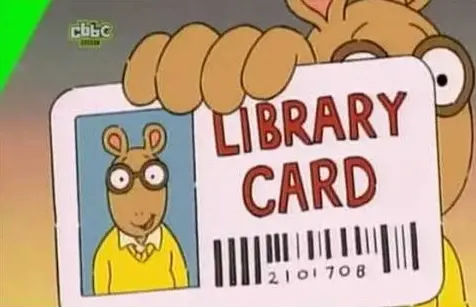
"Having fun isn't hard when you've got a library card!". Photo sourced from Arthur Wiki.
Public Libraries for Film Students and Professionals
Reading books helps our brain move.
One of the main ways inspiration is found is through experiencing other people's works. Art and storytelling is about human connection-- it's why it has been around for so long. When we hit a creative slump or need to remember why we chose the industry we chose, it's a good idea to read stories already written.
Most filmmakers come from a place of passion, and everyone has a favorite movie that got us into the craft. So, why don't we revisit those pieces or find new pieces, like books, that make us feel good? This doesn't mean we have to go back and read something as long or as difficult at The Odyssey-- we can go back and find value in easy-reads like Charlotte's Web, or even something like the Goosebumps series.
And boy does the library have a lot of them.
According to the Carnegie Library of Pittsburgh's website, Main Campus alone has over 2.5 million items, all free to the public. So, you have lots to choose from, and lots of opportunity to scavenge for the right book for you.
You may be a camera head or someone who works in a more technical field, so you may be thinking, "I literally don't need any of this." These 'items' hosted in libraries aren't just fictional storybooks; there also are tons of old textbooks and history books. Books that discuss the development of the practice of filmmaking over decades can help those in more practical parts of the industry.

Reaching out for a book. Photo sourced from Element5 Digital on Pexels.
Expanding your mind to new genres is another perk of the public library. You don't need to pay to try out different genres that you aren't a big fan of. It's good to explore writing territory that you're not used to, or have not favored, as it can really help expand your mind and give you an understanding as to why people like the stories you don't particularly like.
Like romance novels for example. Maybe romance just isn't the kind of read for you, and horror is more your style. But, as some may argue, isn't every story a love story? So why not do some more research on why love stories prevail. Even then, you'd easily be able to find a book that combines romance and horror if you needed to ease yourself into it. These kinds of exercises really help you become a more well-rounded artist and filmmaker.
You don't like the book? You return it and try something else.
But don't swear off all types of books until you really try them. All storytelling is important and it paves the way to newfound filmmaking ambition.

People reading in the common areas of a library. Photo sourced from Pixabay on Pexels.
General Benefits
I'm gonna start this section out with a TikTok...
This is a free public space...
With an endless amount of books...
Computers, WIFI, a quiet place to sit...
Librarians who are (usually) willing to help you...
And a ton of amenities.
Why wouldn't you want to utilize a place like this?
Libraries are a sanctuary for many people for many reasons. We should feel safe to expand our brains and learn from others, as we live in a world where learning, especially as an adult, can appear to be intimidating or embarrassing if you haven't done it since grade school.
Reading a physical book isn't just good for knowledge, but good for your mental health and soul. It can make you feel whole again when you feel like puzzle pieces that don't fit together.
Many libraries have systems that allow you to log in to an online portal from your phone or laptop and place a hold on books you are interested in; if you aren't the type to want to spend hours looking for something you'd like in the building. The Carnegie Library of Pittsburgh specifically allows you to order books in from other CLP libraries, delivered and ready for pickup right at your nearest location (something I use often).
And probably the greatest point of all-- many libraries across the states have abolished overdue fees. Remember being hit with those as a kid and being TERRIFIED to tell your parents about your overdue books you had sitting in the back of your closet?
Yep. They're gone.
Closing Thoughts
Go to the library. Expand your filmmaking knowledge and skills by reading books-- and make yourself feel like a whole human being again. Linked below is WorldCat's Library Locator, so you can find your nearest library if this post inspires you to go.
***Click the image below to access WorldCat's Library Locator***


Comments