
How PUPARIA Explores Consumerism, Self-Discovery, and The World Values of Today.
- Calan Mengel

- Aug 20, 2021
- 5 min read
*** AUTHOR NOTE: Please watch the original video of Puparia, not only to get a sense of what the piece is, but also to support the creator directly. Additionally, I recommend you watch the documentary linked below the original***
PUPARIA (Original)
Shingo Tamagawa - Three Minutes, Three Years: Making Puparia
SPOILERS AHEAD
"I thought that pursuing that path would make me start hate my drawings. I would start to hate even the simple act of drawing."
~ Shingo Tamagawa
from Shingo Tamagawa -
Three Minutes, Three Years:
Making Puparia
In the film, TV, and animation industry, lulls of artistic inspiration are very real things, and they happen all the time. It's that obstacle that is larger than life, looming over the artistic individual, waiting to pounce-- sometimes when you least expect it. Keeping that creative spirit alive can provide to be a challenge at times during the lifespan of those in the industry. This can be for a variety of reasons: lack of drive, traumatic personal event, grief, loss of hope, the crushing of dreams by others, and the upsetting reality of capitalism and consumerism in the industry.
Sometimes obstacles can lead to the creation of some of the most beautiful pieces. Today, I'd like to highlight and discuss one of these.
This is Puparia.
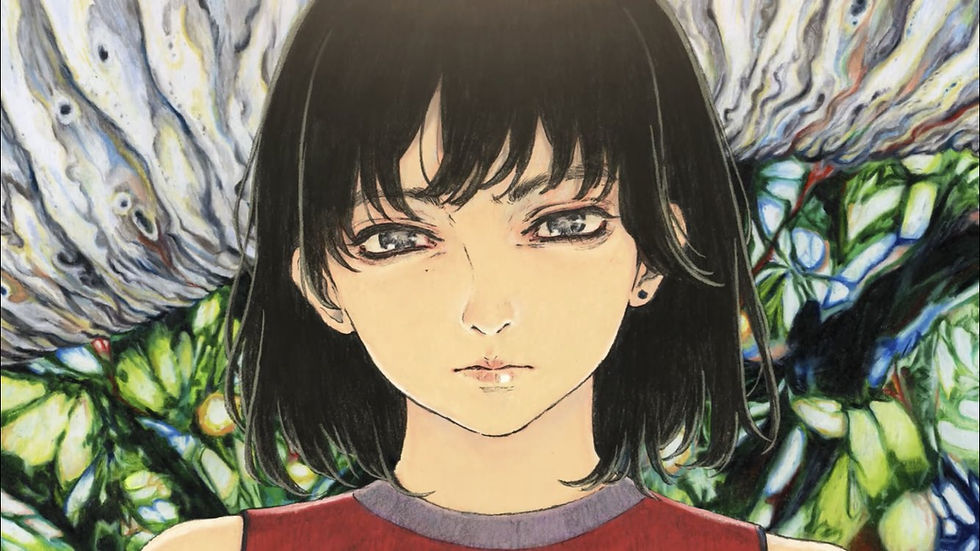
A shot from Puparia. Photo sourced by fellow writer Matt Schley's post on Otaku Magazine USA.
Puparium - a rigid outer shell formed from the larval skin that covers some pupae (as of a dipteran fly)
~ Merriam-Webster
Three years of hard work-- three minutes of animation. Director and animator Shingo Tamagawa had made this masterpiece all on his own, afraid of burdening other with his passion project.
According to the 20-minute documentary by Archipel on YouTube, Tamgawa went to school for animation, then grad school, where he eventually dropped out, heading straight into the animation industry in Japan. Throughout his 5 years of working, he felt like he was loosing himself and the important meanings that should go into animation (Archipel). After much consideration, he fully stopped animating in 2015.
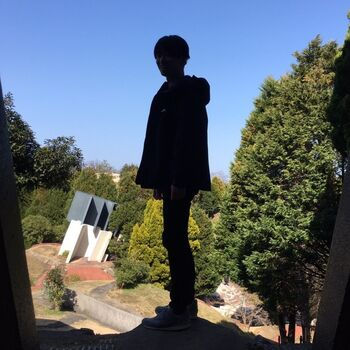
A photo of Shingo Tamagawa. Photo sourced from Wikitubia.
Tamagawa talks about the time he spent not animating after 2015. During the interview, he explains he did a lot of reading and walking outside, spending time with himself. After about a year and a half, Tamagawa reclaimed interest in animating a piece. These were the early beginnings of Puparia.
"Nobody had asked for it, but I thought I'd give it a try and start." he states in the documentary. Tamagawa used the memories he collected during his time of solitude as inspiration for the animation. "It was as if I wanted to leave a trace of my mindset of that time wandering around, not doing anything."
What I take away from this timeline, as a viewer and a fellow artistic head, is that creative people need times to develop their ideas. We are not robots-- we can't pump out stories, ideas, animations, songs, and other forms of art that are top notch at the speed of light. Meaningful, detailed pieces of work take time, nurturing, and rest. We cannot always keep up with the pace capitalism wants us to. Sometimes it even takes time for us to grow as individuals, at our own pace, so that the work we eventually decide to showcase to our friends, family, and even the public eye make a larger impact and speak loudly for or against things in our society.
Puparia discusses themes of solitude, expressionism, and the values of today's world. We follow these characters, who say no words, as they look at different things: down a hall, at another character, off screen right, or even right at us. They wonder and observe as we wonder and observe. Who are these individuals? Why are they here in this fantastical world? What are they looking at? Why are they staring? Are they looking in amazement, confusion, disbelief?
Through the piece and the documentary, Tamagawa speaks about those values that shaped the world, and how they are fading away. He explains that he believes people started to realize this even before COVID-19 hit; that we cannot be our true selves, and that we cannot see the future. These themes ring true through the eyes and motions of the characters in the piece.
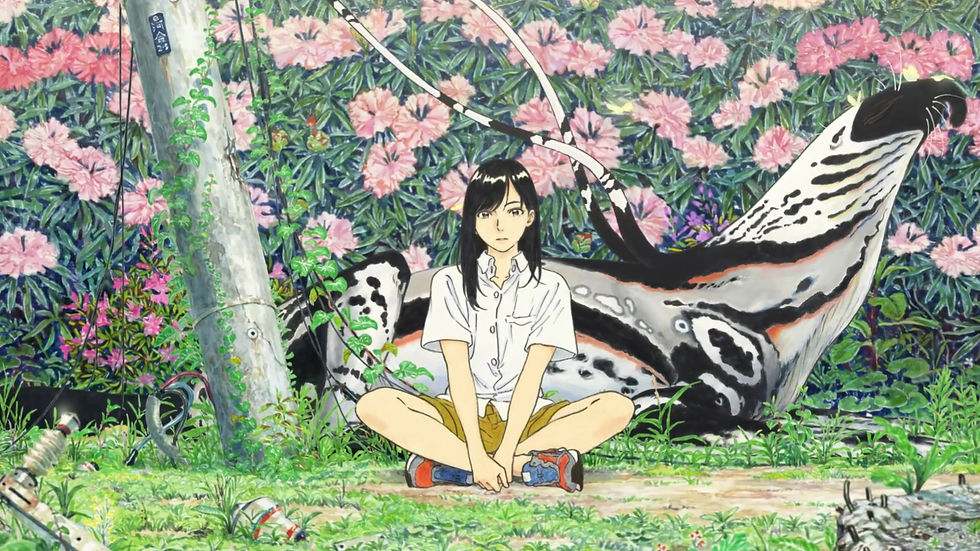
Another shot from Puparia... is she staring at us? Why does she stare at the viewer?
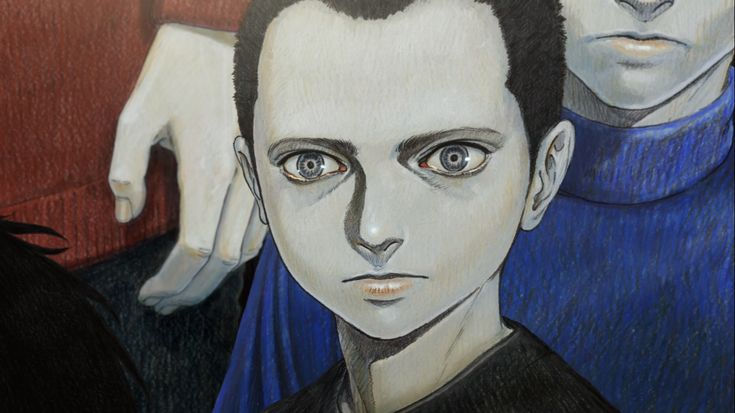
One more shot from Puparia. What does the young man stare at? Is his expression interest, disbelief, wonder? Or is he captivated with what's in front of him?
For the visuals, Tamagawa explains he wanted his drawings to be "clear with no deception... nothing blurry or confusing to the viewers". That is why he chose to draw by hand and had taken much inspiration from manga. For many, manga can come off as too straight forward and 'cheap' with its strong symbolism to some, according to Tamagawa, but this is what he wanted for Pupara: clearness.
Rounding back to expressionism, Tamagawa wanted the faces of each character to feel alive... not through being hand drawn, though, but through their movements.
One of the most compelling characters in the piece is the alien-like person at the end of the piece. In his interviews, Tamagawa specifically mentions that this person is neither a boy or a girl and is just a person, which I feel fits very well for the character. They are so compelling, and the final scene speaks volumes about the piece overall.
In the scene, we have the alien-like humanoid who looks straight forward at the horizon. A deer-like being next to them observes as well, looks towards our character, then runs off towards the horizon. After a moment, our character turns around-- there are tons of people staring at them. For what reason is unknown, but there is a sense of wonder, amazement, and happiness in the smile our character gives the crowd before quickly turning around and moving forward (maybe moving forward with life).
This forward motion is graceful and pure- this character looking ready to take the unknown future head-on, whether it be good or bad. Part of me wonders if they are trying to tell us to not be afraid of the future since it's so unknown. Sure, we can fear the unknown, by why bother when we don't know what's going to happen. This is all speculation, but it's that character's smile that really ties the piece together.
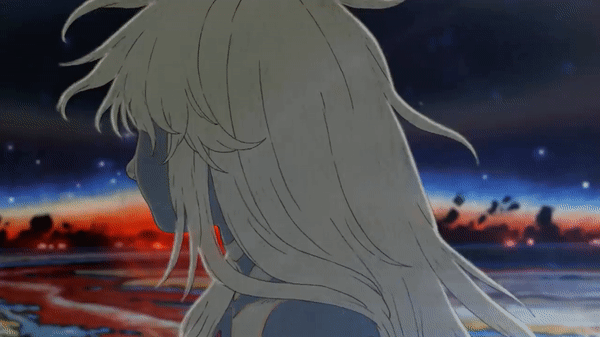
Our beautiful ending character... GIF sourced from Pinterest.
Overall, Puparia, in my opinion, is a breakthrough not only in animation, but in the minds of the creative individuals. What once was a time of uncertainty and solitude for Tamagawa is now art: art he wanted to make and that he completed on his own in a one-man show. What is amazing about his work is that he brings these uncertainties, these fading values, these times of wandering in the mind, body, and soul, into the viewer's mind and heart to contemplate and digest as their own individual.


Comments